.svg)


Resource management is evolving fast. Where does your team stand? Our second annual State of Resource Management report reveals how the function is shifting in 2026 – from the fight for strategic recognition to AI adoption to the tools teams actually rely on.
In 2026, RM data is doing real work: executives are leaning on it to make decisions, finance teams are building it into forecasts, and it's even shaping difficult calls around headcount. Capacity planning and utilization tracking have become standard practice across most organizations.
But influence hasn't translated into status. The function still tends to get absorbed into operations, valued for keeping delivery on track rather than for shaping where the business goes next. Data trust is improving, but confidence in RM insights is rarely unconditional. And while AI has captured plenty of attention, most organizations are still watching from the sidelines.
Almost half of respondents named tasks relating to matching supply to demand as their top resource management objective, pointing to a growing maturity in the discipline. Financial and people-centric goals languish lower on the list, suggesting a shift towards using resource management to align talent with future demand, not just today’s delivery needs.
What this year's findings really show is a profession caught between two versions of itself. Commercial pressure demands more value to be squeezed from existing capacity, but visibility gaps and messy, fragmented data keep getting in the way of strategic ambition. AI could help close that gap, but without the right systems and governance in place, it's not going to do the heavy lifting on its own.
Resource management has come a long way in recent years; in 2026, it’s influential but not yet institutionalized. Trusted, but still earning its seat at the table. The organizations that figure out how to move from execution support to genuine strategic orchestration will be the ones that shape what this discipline becomes next.
Resource management is growing in influence, but its structural position hasn't kept pace. RM data is now shaping strategic decisions, workforce planning, and revenue forecasting in many organizations – yet the function itself tends to sit within operations or delivery, seen as execution support rather than a strategic voice. The influence is real, but the authority isn't always there to match it.
In 2026, resource management is firmly embedded within operational functions. Over a third of respondents say RM sits within Operations, followed by 23% who say it’s part of Project, Program, or Portfolio Management. This marks a clear shift from 2025, when Project, Program, or Portfolio Management led at 31%.
The movement toward Operations suggests a transition away from project-centric oversight and toward broader operational ownership. Decentralized models have declined slightly (10% vs. 12% in 2025), while HR ownership has increased (9% vs. 4%), indicating closer alignment between workforce strategy and resourcing decisions.
.png)
Using the RMI’s Resource Management Maturity Model, we asked respondents to assess their process maturity.
Most organizations cluster around mid-level maturity. 40% report operating at Level 3, where standardized and documented processes drive structured planning, while 37% sit at Level 2, working with basic but inconsistent processes.
Compared to 2025, the share of highly mature organizations has declined. Just 6% consider themselves to be operating at Level 5, echoing the fact that dedicated Resource Management Offices (RMOs) remain rare (2%). Level 4 has dropped from 17% to 9%, while at the lower end, Level 1 has more than doubled.

The fact that formal RMOs remain rare says something important. Operational integration helps teams stay responsive, but without centralized governance structures, the kind of maturity that drives real strategic change is still out of reach for most organizations.
The hybrid model is the most common resource management structure in 2026, with 37% of organizations combining centralized oversight with distributed ownership. This reflects a pragmatic middle ground where organizations are balancing governance with agility.

Despite growing strategic importance, resource management is rarely a deliberate career path. Only 4% intentionally pursued a career in RM with most transitioning from project management, operations, HR, or administrative roles.
Others describe RM tasks as just one aspect of their broader position. This highlights that while many businesses have a need for RM, it is often enveloped in existing roles.
It's not really my job, but a by-product / need.”
Just another hat.”
Took care of RM as part of an operations management role.”

Just over half of organizations say their resource management function has grown in the past 12 months, a slight increase from 49% in 2025. Contraction has also risen, from 13% to 19% this year, while functions remaining stable dropped from 38% to 30%.

Underneath many of the challenges this report surfaces, there's a quieter problem: perception. What resource management does matters – but so does how it’s seen by the wider business. Both will shape its role as a strategic driver of business performance.
Interestingly, half of organizations still frame RM as an operational, execution-oriented function, with a third (32%) saying it is viewed as delivery support, and 18% considering it a scheduling function. Just under a quarter view it as a strategic capability.
While the function has clearly evolved beyond pure scheduling, our data suggests true strategic positioning remains uneven.

Encouragingly, resource data influences strategic decisions in nearly 9 in 10 organizations. However, the depth of influence varies. While 19% describe RM as central to strategic planning and 28% say it actively shapes decisions, for the largest group (40%), it validates rather than drives decision making. Most concerningly, 9% say resource data is an afterthought.
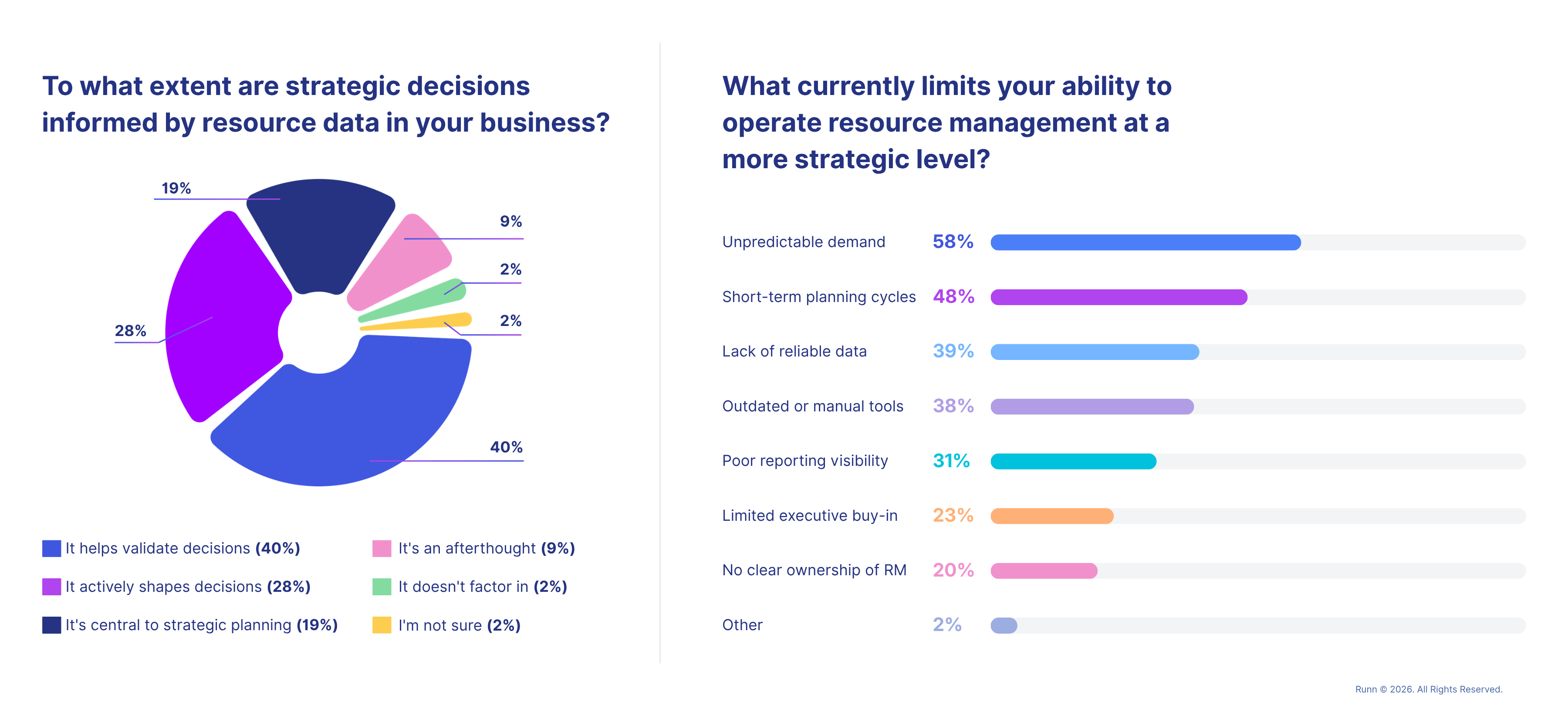
The biggest barriers to operating more strategically point to instability, rather than a lack of intent. Unpredictable demand (58%) and short-term planning cycles (48%) top the list of barriers, followed closely by data tooling constraints cited by nearly four in 10 respondents. This pattern suggests that when demand shifts rapidly, RM is forced into reactive execution – and away from forward-looking strategy.
Companies seem to still not fully understand the capabilities of an RMO. Many believe it is simply assigning resources to projects.
I do wonder about the value a resource manager can bring in light of AI. I can see that the human element is still needed, but I can see the role of resource manager being merged into other roles – operations manager, delivery manager, more and more in the future due to the AI enhancements.
The function often lacks a meaningful voice within organizations. Resource management touches revenue, delivery quality, employee experience, and client outcomes, yet is frequently excluded from strategic conversations. This role should have a strong seat at the table with the ability to actively participate in decision-making.
I am observing a shift away from Resource Management as a standalone function. Instead, it's becoming embedded in day-to-day operations focused more on capacity and efficiency.
In a year where alignment and efficiency dominate the agenda, patchy visibility might be the most underappreciated barrier to progress. Organizations are after proactive, predictive resource management, but that requires foundations that haven’t been fully built yet. Fragmented data, inconsistent inputs, and limited visibility into capacity and demand are still widespread problems. Until systems talk to each other and data governance catches up, strategic ambition will keep running into operational ceilings.
The biggest challenges facing resource management this year center on data quality and visibility. Nearly half cite inconsistent or incomplete data (48%) as a key obstacle. It’s then unsurprising that a lack of visibility into capacity and demand (47%) and misalignment between the two (42%) follow quickly behind.
Despite a growing focus on data foundations, concerns about outdated tooling haven't shifted from last year.
41% consider this a challenge today compared to 42% in 2025. As visibility gaps become harder to ignore (only a third of respondents say they’re “satisfied” with their level of visibility), the cracks in data integrity and system integration are getting more exposed.
Tools built for the job matter here. Without them, maintaining trustworthy data on supply and demand becomes an uphill struggle, and proactive planning stays out of reach.

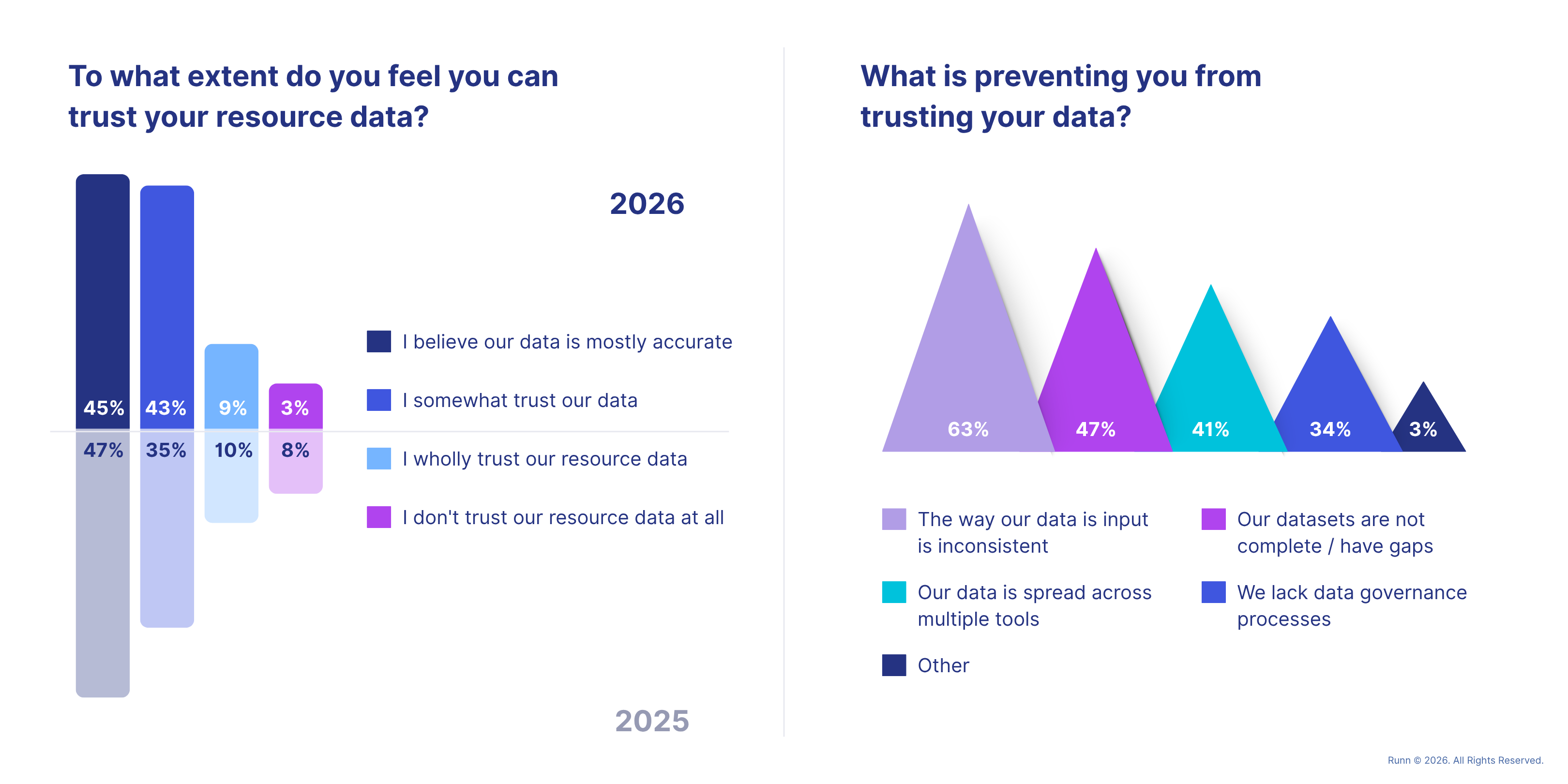
Following the above trend, confidence in resource data is strengthening slightly, though unconditional trust remains low.
87% somewhat trust their data or believe it’s mostly accurate, up from 82% in 2025. Encouragingly, the proportion who do not trust their data at all has dropped significantly (8% to 3%).
However, just 9% wholly trust their data, citing inconsistent data inputs as the top barriers to trust (63%). Data gaps are also a challenge for 47%, while 41% say their data is fragmented across tools. The data suggests gradual improvement in reliability, but the kind of unquestioned data foundation that genuine strategic planning requires isn't there yet for most organizations.
Just over half of respondents describe their approach to resource management as more proactive, compared to 48% who say it remains reactive. This marks a modest shift from 2025, when reactive approaches held a slight majority (51% vs. 49%).
The balance is tipping toward proactive planning, but plenty of organizations are still working in reaction mode. Without consistent forecasting habits, connected systems, and data people actually trust, teams risk slipping back into short-term firefighting rather than building the visibility needed for truly proactive planning.

When asked what resource management activities they find the most valuable, most respondents pointed towards those centered on adaptability and forward planning. Nearly half (48%) said managing change was one of the most valuable parts of their role, closely followed by updating forecasts (44%) and balancing workloads (43%).
There's a clear gap between understanding and doing. Most practitioners acknowledge that inconsistent data is a major barrier, yet relatively few rank data hygiene as a priority part of their role. This suggests that while people understand the importance of clean data, it tends to get deprioritized in practice.
Professionals gravitate toward the parts of their role where they feel their impact most directly: enabling strategy, not maintaining systems.

In a practice that relies so heavily on data, reporting is always going to be important.
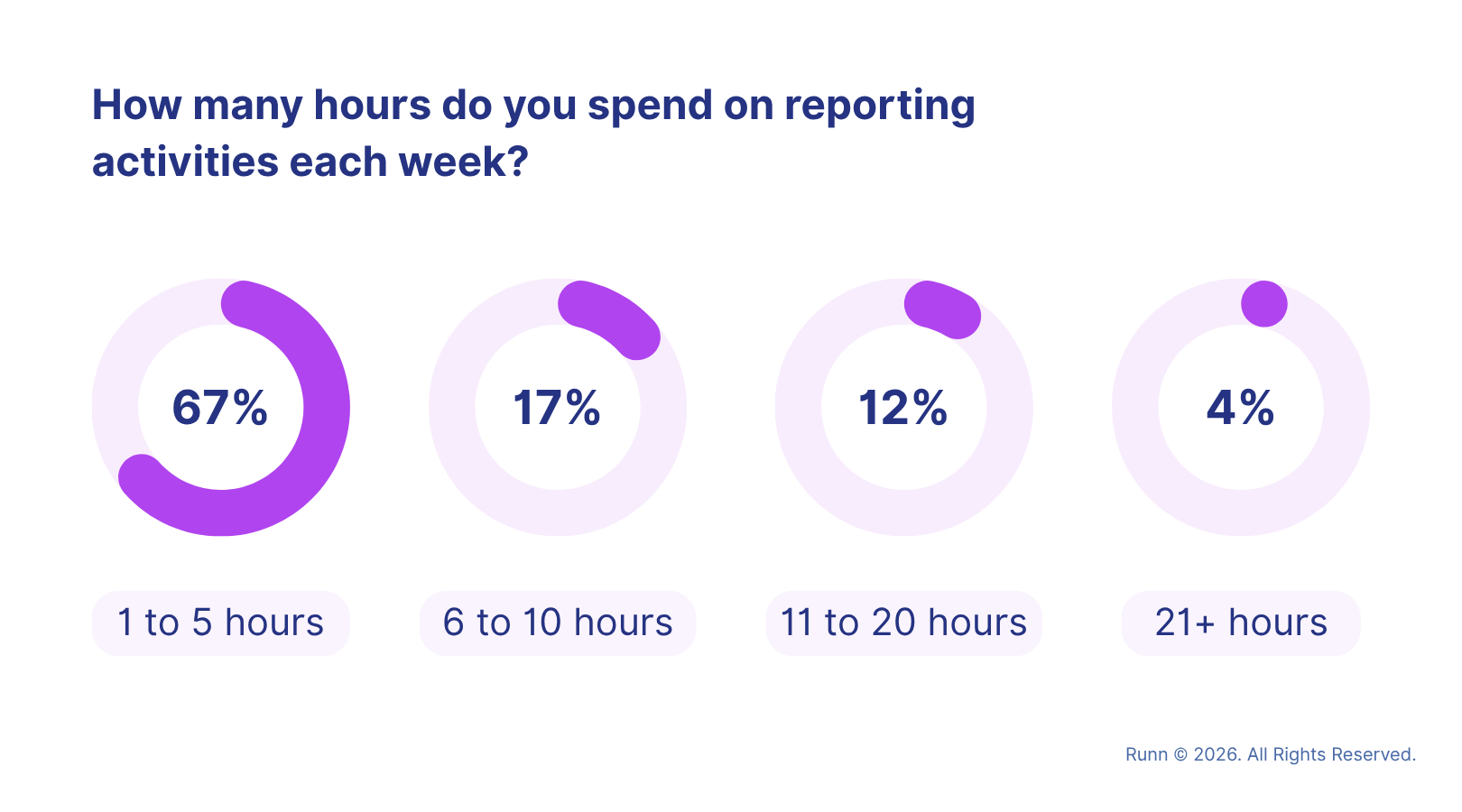
On average, respondents spend around 6.5 hours per week on reporting activities, down from 7.5 hours last year. Over two-thirds (67%) spend between one and five hours per week on reporting, while just under a quarter dedicate between six and 15 hours. A minority feel a very heavy burden, with 7% spending 20+ hours per week on reporting activities.
Reporting demands may be easing slightly, potentially thanks to better tooling or streamlined processes. However, 6.5 hours is still nearly a full working day each week dedicated to reporting. For organizations serious about elevating RM into a more strategic function, cutting down on manual reporting overhead is one of the most immediate opportunities available.
Resource management data is widely used across leadership, sales, delivery, and finance, shaping hiring decisions, deal timing, staffing plans, and revenue forecasts.
Across functions, though, reporting requests tend to focus on the same territory: performance and predictability. People-centric measures (e.g., engagement, development, long-term workforce planning) rarely make the list. It’s a telling pattern: commercially, RM is well integrated, but its strategic influence is still largely filtered through an execution and financial lens.
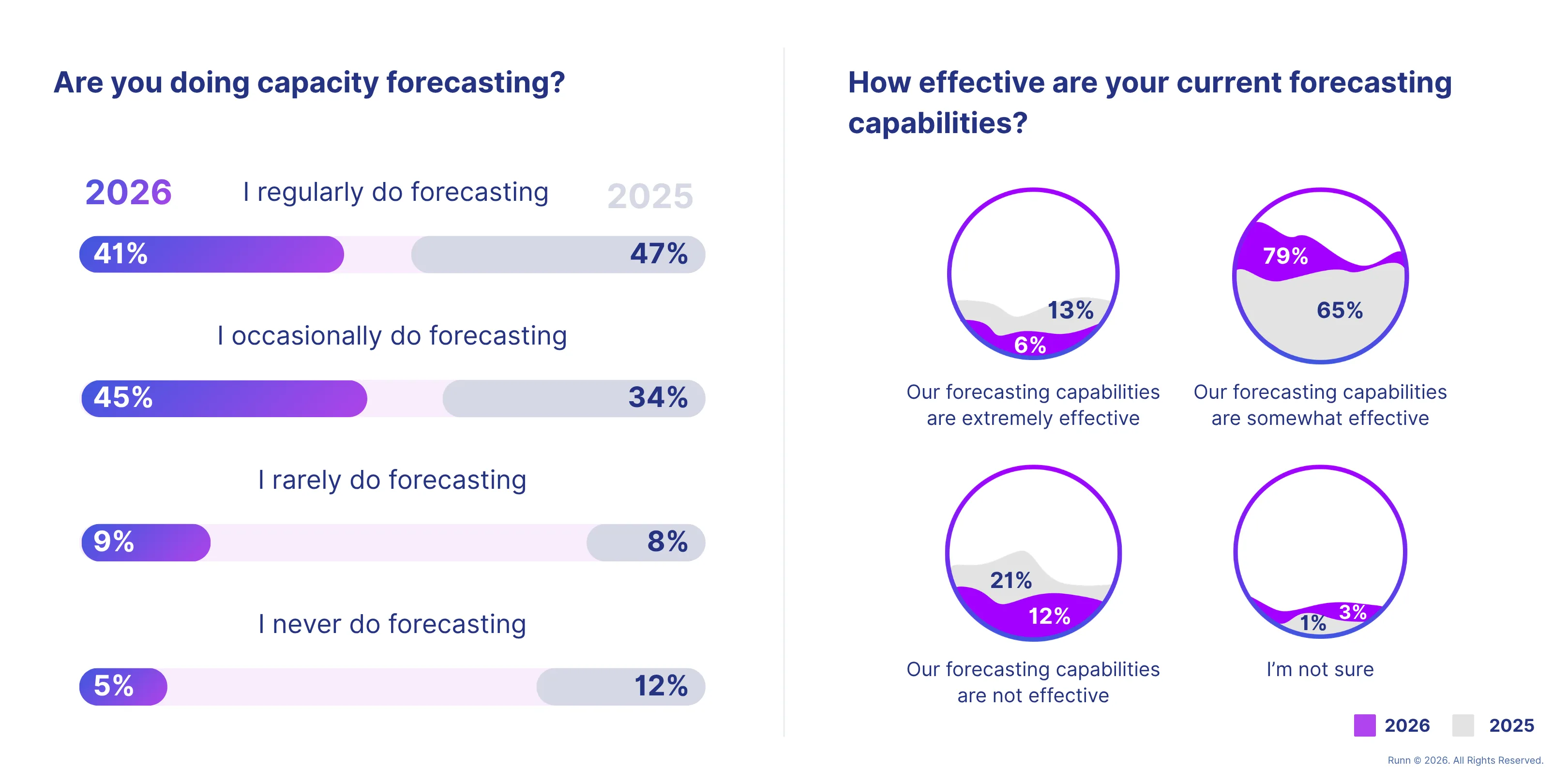
Capacity forecasting is now a nearly universal activity, with 86% of respondents forecasting either regularly (41%) or occasionally (45%), up from 81% in 2025. The proportion who never forecast has dropped sharply (12% to 5%), signaling broader adoption.
Confidence in efficacy, however, has settled in the middle. Most rate their capabilities as somewhat effective (79%, up from 65%), while fewer now describe them as extremely effective (13% to 6%). Forecasting is becoming standard practice, but true efficacy remains rare.
In theory, longer-term forecasting enables better strategic planning. Yet most organizations forecast within operational timeframes. 71% forecast up to three months ahead, while 19% look six months ahead. At the extremes, a minority (3%) relies on very short-term planning while just 10% forecasts a full year out.
With forecasting skewed toward near-to mid-term delivery alignment rather than long-term workforce strategy, few organizations are extending visibility far enough to fully integrate resourcing with annual planning cycles and broader strategic goals.
Resource management is increasingly tied to commercial performance. Profit margins top the list of priority KPIs, closely followed by utilization. When revenue targets are missed, low billable utilization is the most common culprit, reinforcing how tightly RM is linked to financial outcomes.
The people story, however, is more nuanced. While most respondents say engagement and retention are considered in resourcing decisions, far fewer rank employee retention among their top KPIs. The intention to balance performance with sustainability is there, but success metrics still lean toward financial and operational outcomes.
Just over half of organizations say they hit their 2025 revenue targets. 20% fell short, with a further 29% describing their financial performance as being "complicated." In other words, for nearly half the market, results were either under target or uneven.
Among those who missed their targets, low billable utilization stands out as the dominant challenge (53%). Scope creep (29%) and limited skills (24%) follow, a reminder that revenue shortfalls are rarely just a demand problem. Often, they come down to how well capacity is being forecasted and planned in the first place.
.png)
Rather than chasing growth at all costs, most organizations are focused on execution. Top priorities for the year include aligning capacity and demand (58%) and improving operational efficiency (58%), followed by increasing utilization (46%).
In 2025, capacity planning and increased utilization topped the agenda. This year’s data shows those themes are strengthening. RM is doubling down on fundamentals, like matching supply to demand, improving efficiency, and driving performance with better alignment.

Resource management is evolving, but for many organizations it's doing so against a backdrop that still feels financially and structurally uncertain.
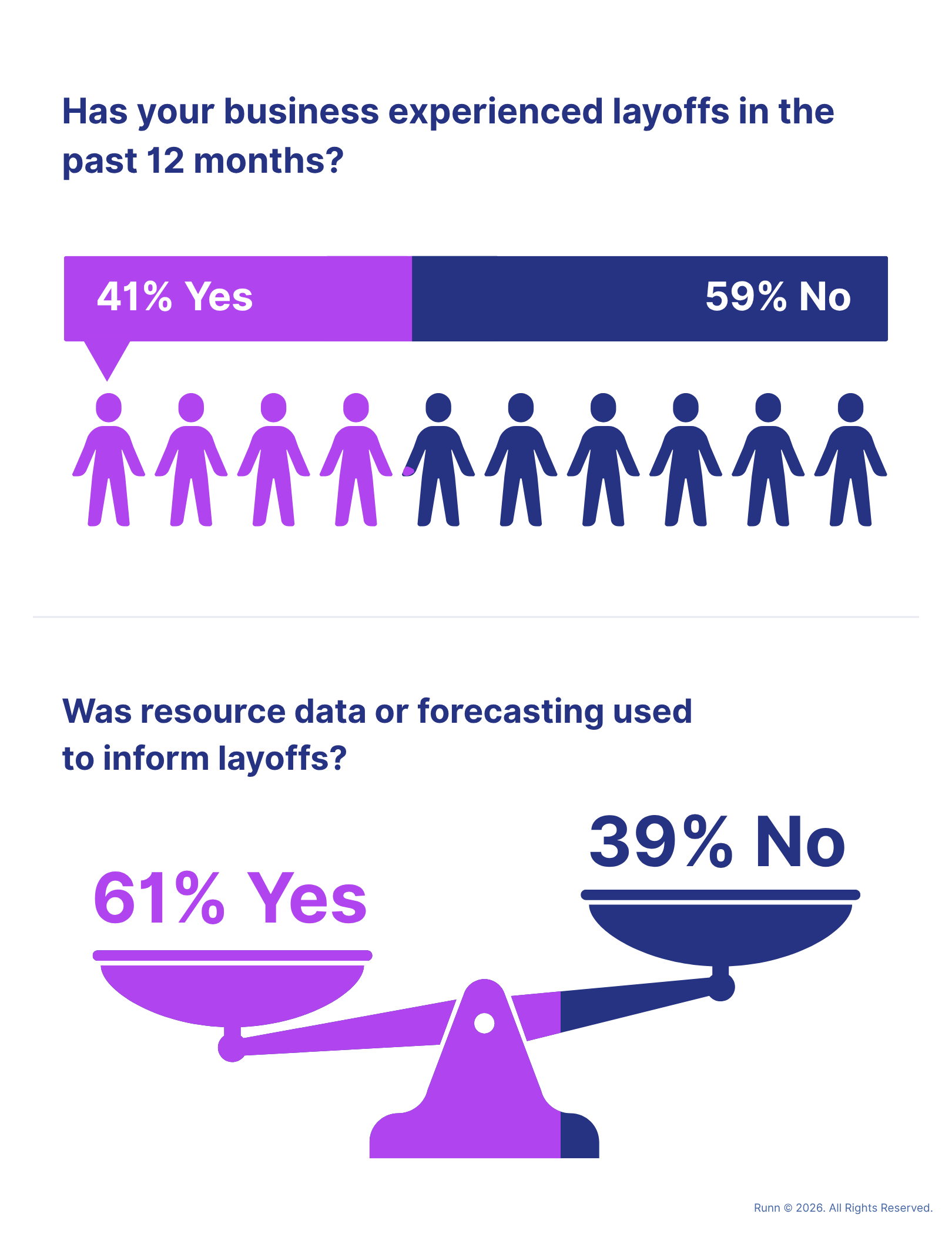
Four in 10 respondents report their business experienced layoffs in the past 12 months. Although the majority avoided workforce reductions, the proportion affected is substantial.
Among those that experienced layoffs, close to two-thirds say resource data or forecasting was used to inform those workforce reductions. This underscores resource management’s growing financial influence; it is increasingly being tied to cost discipline and structural workforce decisions.
Resource management’s ties to financial and operational performance are getting stronger, but people-centric metrics haven't disappeared from the picture. They still factor into what organizations say they care about most.
Profit margin steams ahead on our list of priority KPIs, with over two-thirds naming it a KPI they care about. This is followed by utilization increases (54%), showing that – perhaps unsurprisingly – a strong commercial lens continues to shape RM decisions.
Project quality (53%) and client satisfaction (51%) also remain central, suggesting that performance is measured not just by efficiency, but by delivery outcomes and customer impact.
Notably, employee retention ranks lowest on our list, despite broader recognition of burnout and engagement pressures elsewhere in this report.
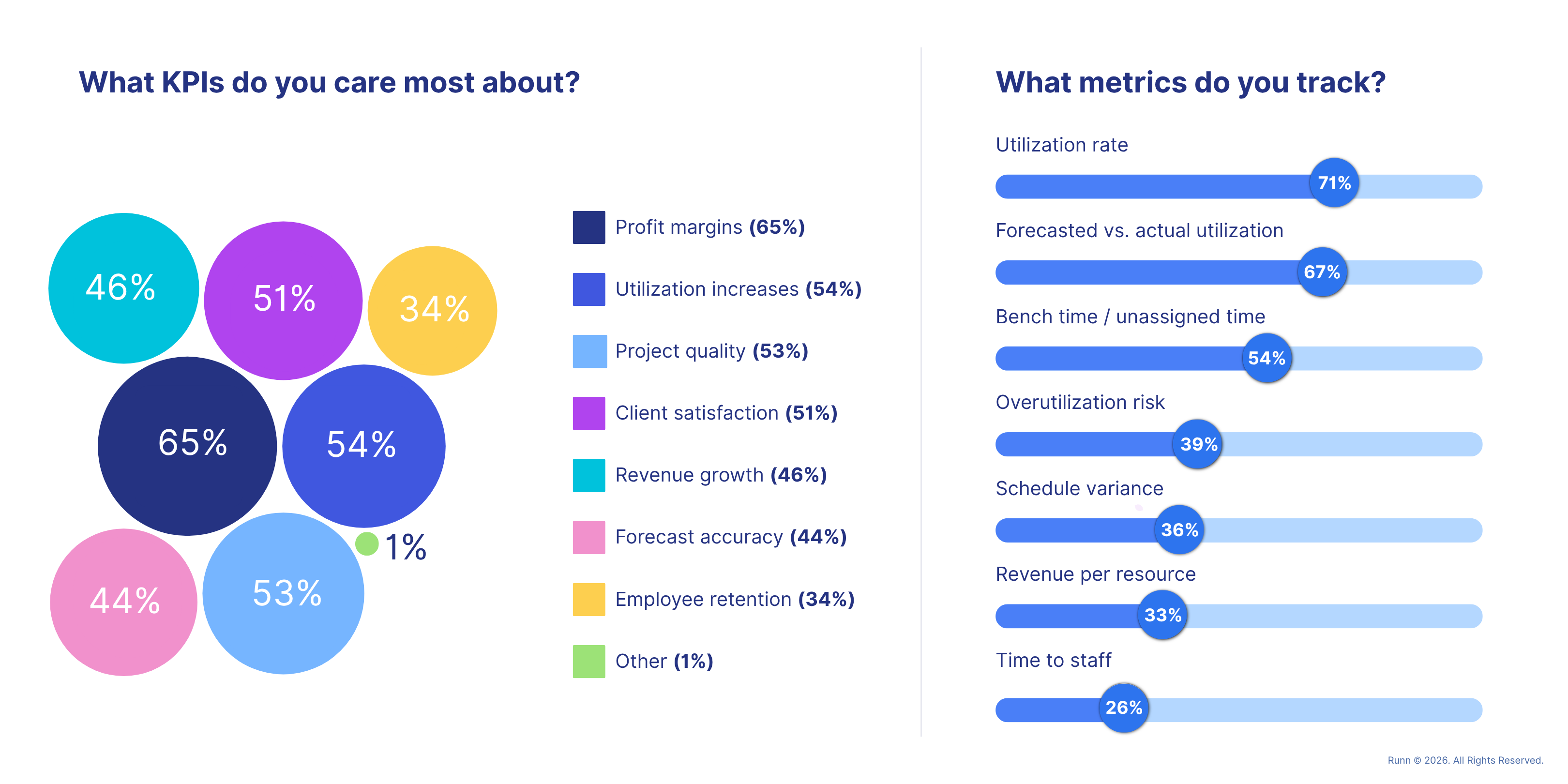
Utilization continues to anchor resource management measurement. 7 in 10 told us they track their utilization rates, while two-thirds monitor forecasted vs. actual utilization, making performance against capacity a key focus for the majority of businesses.
Understanding how people’s time is being used is evidently a top concern, with half of teams tracking bench time and almost two in five looking at overutilization risk. This data can be used to maximize productive capacity while managing strain.
Commercial and operational metrics show up as secondary metrics. A third track revenue per resource and just over a quarter monitor time to staff, suggesting that the primary performance story, for now, centers on how efficiently people are deployed, not yet how profitably they are aligned.
Respondents report a 72% average utilization rate, showing most organizations appear to be operating within a relatively sustainable performance range. Many professional services organizations aim for around 80 – 85% overall scheduled resource utilization, though benchmarks vary by industry.
Curious how other teams measure utilization? We found that 7 in 10 calculate utilization using workload divided by effective capacity, factoring in time off and non-working hours rather than relying solely on contracted capacity. This formula provides a more realistic view of performance and avoids overstating availability.
Cold, hard data is integral to good resource management practice. However, the human element should never be forgotten. After all, in this context, “resource” does relate to people.
Despite only a third of respondents stating employee retention is a KPI they monitor closely, resourcing remains human-first. Seven in 10 said that engagement and retention are explicit considerations in their resourcing decisions.

Utilization thinking is here to stay. But there are signs organizations are no longer placing it center stage.
As the pressure to deliver efficiently runs up against the very real costs of burnout and employee turnover, sustainable performance is increasingly being understood as something that can't be reduced to filling capacity gaps.
AI is everywhere, but within resource management, adoption is moving slowly. Interest is genuine (particularly around forecasting and scenario modeling), but most teams aren’t rushing in. There's a widely-shared recognition that without clean, connected data behind it, AI can't deliver the transformation people hoped for. It’s seen as something that sharpens human judgment rather than replaces it, and most organizations seem comfortable sitting with that – at least for the time being.
Dedicated resource software overtakes spreadsheets
Dedicated resource management software (54%) has overtaken spreadsheets (44%) as the most common way organizations manage resources.
Last year, spreadsheets dominated at 58%, while RM software sat at 44%. This reversal signals a meaningful step toward more structured, purpose-built tooling. Two in five of those using spreadsheets also use a dedicated resource management tool.
Adoption of project management software has also increased (24% to 38%), and BI tools have more than doubled (7% to 16%), suggesting growing appetite for integrated reporting and analytics.
The move toward greater systemization is consistent with a broader pattern in this year's data: organizations are investing in tools, but the gains will be limited until fragmentation and data trust issues are properly resolved.

A majority of organizations now track skills in some form, with 60% doing so either via a dedicated tool (31%) or a spreadsheet (29%). This represents a slight jump in tool-based tracking from 2025 (up four points from 27%), while spreadsheet reliance has remained broadly stable (down two points from 31%).
However, gaps remain. 24% say they want to track skills but do not yet do so, and 16% have no plans to implement skills tracking at all. Compared to last year, the share with no plans has increased slightly. There’s movement here, but it’s incremental. Skills intelligence is still far from being standard practice across the market.

Most organizations track skills, but the way they're doing it tends to be tactical rather than strategic. Strategic workforce planning applications – such as succession and scenario modeling – lag behind, reinforcing the pattern of execution over long-term planning.
The skills data that is tracked is used primarily for staffing and execution-related tasks – core operational levers. Three-quarters use skills data to ensure the right people are placed on the right work at the right time, while roughly half use it to balance capacity and demand.
Strategic applications are less prominent. While 43% use skills data to inform learning and development planning, only 28% apply it to scenario planning and 24% to succession planning. Skills intelligence is working hardest to optimize current delivery, while longer-term workforce planning and future-proofing remain underdeveloped.
It's another instance of execution taking precedence over foresight.
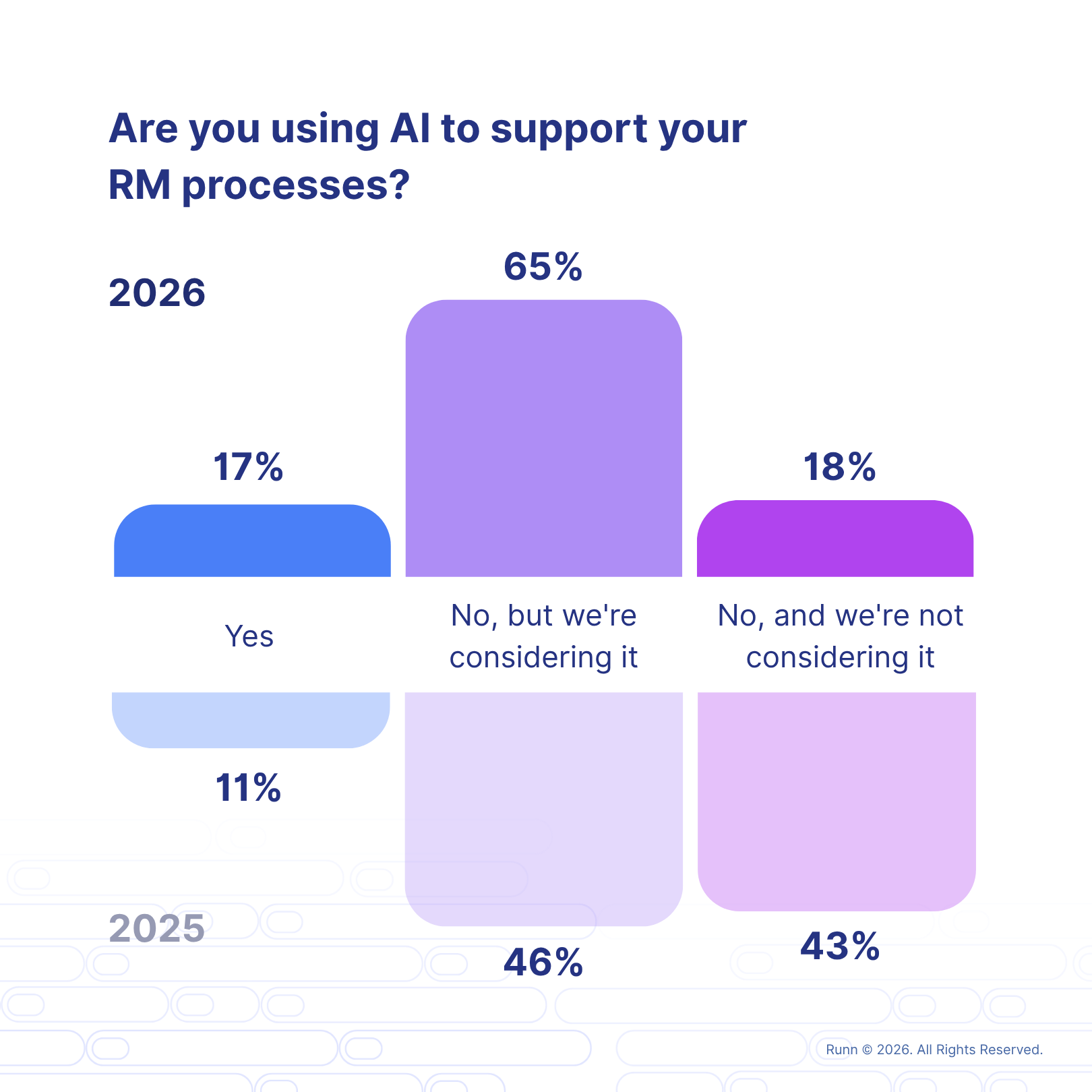
AI adoption remains nascent – a rational response in a space where only 9% wholly trust their resource data. Without stronger data foundations, AI risks amplifying inconsistency rather than solving it.
Just 17% of organizations say they are currently using AI to support their RM processes. However, a clear majority are considering it, while 18% say they’re not exploring AI at all.
This tracks with cautious curiosity. While enthusiasm for the benefits AI can bring is evident, most organizations appear to be a long way off implementing AI solutions.
As data trust, forecasting maturity, and tooling integration improve, AI adoption may accelerate – but for now, it remains more anticipated than a reality.
Interest in AI is strongest where it strengthens foresight and decision-making, acting as a planning accelerator enhancing visibility and strategic foresight rather than as a replacement for human judgement.
Automated forecasting (56%) and what-if analysis (55%) top desired capabilities, followed by predictive risk alerts (45%).
This suggests organizations prioritize planning accuracy and earlier issue detection over administrative automation.
Skills inference (43%) and automated scheduling (42%) also rank highly, indicating demand for smarter workforce allocation. Meanwhile, 32% see value in an AI assistant, and 12% find none of these capabilities useful.

AI has helped us move from chatbots to autonomous agents that effectively manage complex staffing workflows and predictive demand sensing. These capabilities align with the technical vision, but many organizations still struggle to scale these tools beyond pilot phases because of fragmented data foundations.
AI has added value to resource management by improving trend analysis, forecasting support, and automating reporting, but it hasn’t become the fully predictive “autopilot” many expected by 2026. Its effectiveness still depends heavily on clean data, consistent processes, and clearly defined roles.
AI models now predict demand, consumption, and maintenance needs with far greater accuracy than before.
I haven't used AI in resource management yet, but I've used it in other areas, and it's very helpful. Would love to see more on how it could assist in this space.
AI is helping us analyze past performance and future predictions.
By 2026, I expected AI to be a 'set it and forget it' autopilot, but it's really just a high-maintenance intern that still needs me to double-check every single forecast because the AI hallucinates based on bad inputs.
AI is only as good as the data inputs, otherwise it is garbage in, garbage out. AI can be used as a tool, but someone needs to own the governance. Additionally, while AI can add insights, it can also make mistakes - it’s almost like an overconfident coworker who is intelligent but doesn't check their work and yet still insists they are correct.
We’re seeing progress in automated forecasting and resource allocation, but predictive models are still evolving. The potential is clear, especially for AI-assisted decision-making, but we’re not quite there for dynamic, real-time planning.
Not fully. There’s a lot of promise, but most AI in resource management still feels surface-level. I expected stronger automation for forecasting, skills matching, and proactive risk detection. We’re still spending too much time manually reconciling data instead of letting the system do the heavy lifting.
This year’s findings show functions with growing influence, but uneven foundations.
Resource management is shaping executive conversations, informing workforce decisions, and underpinning financial performance. Forecasting is widespread. Utilization is closely monitored. Skills tracking is growing. The discipline is more visible and more relied upon than ever before.
And yet, many teams are still navigating fragmented systems, uncertain data trust, and short-term planning horizons. Strategic ambition is present, but it keeps running into operational constraints.
AI is part of the conversation, but most organizations recognize that without stronger data foundations, it won’t deliver transformation on its own.
The next stage of resource management is about clarity, not expansion. Teams that want more confidence in their forward-looking visibility should focus on strengthening data governance and building better-connected systems. Those that start now will be best positioned to turn influence into authority, and execution into orchestration.
If strategic influence, financial predictability, and operational clarity are your goals, the next step is investing in systems that make them possible.
Ready to power strategy with resource management software?







.png)