Still scheduling by availability or roles? You may be missing your team's full potential. Here's how skills-based resource planning changes everything.

Skills-based resource planning is about allocating people to projects based on more than just availability. As the name suggests, it takes people’s skills and levels into account, too.
It might sound obvious that managers would allocate resources to projects based on whether they have the right skills. But many firms simply lack the information they need for skills-based resource planning, or struggle to justify investing the time and effort in skills tracking.
Often, it’s because, historically, the business has been small enough that they’ve just known what people are good at. But, as the business has grown, they’ve lost that knowledge and not replaced it with a systematic approach to capturing and using it.
In this article, we’re going to show you how to do it – with insights from three resource management experts – Cyd Mills, Julie McKelvey, and Oli Meager.
Traditional resource allocation often considers a limited range of available information – namely, capacity, availability, and current allocations. Whereas skills-based resource allocation also considers relevant information about people’s skills too.
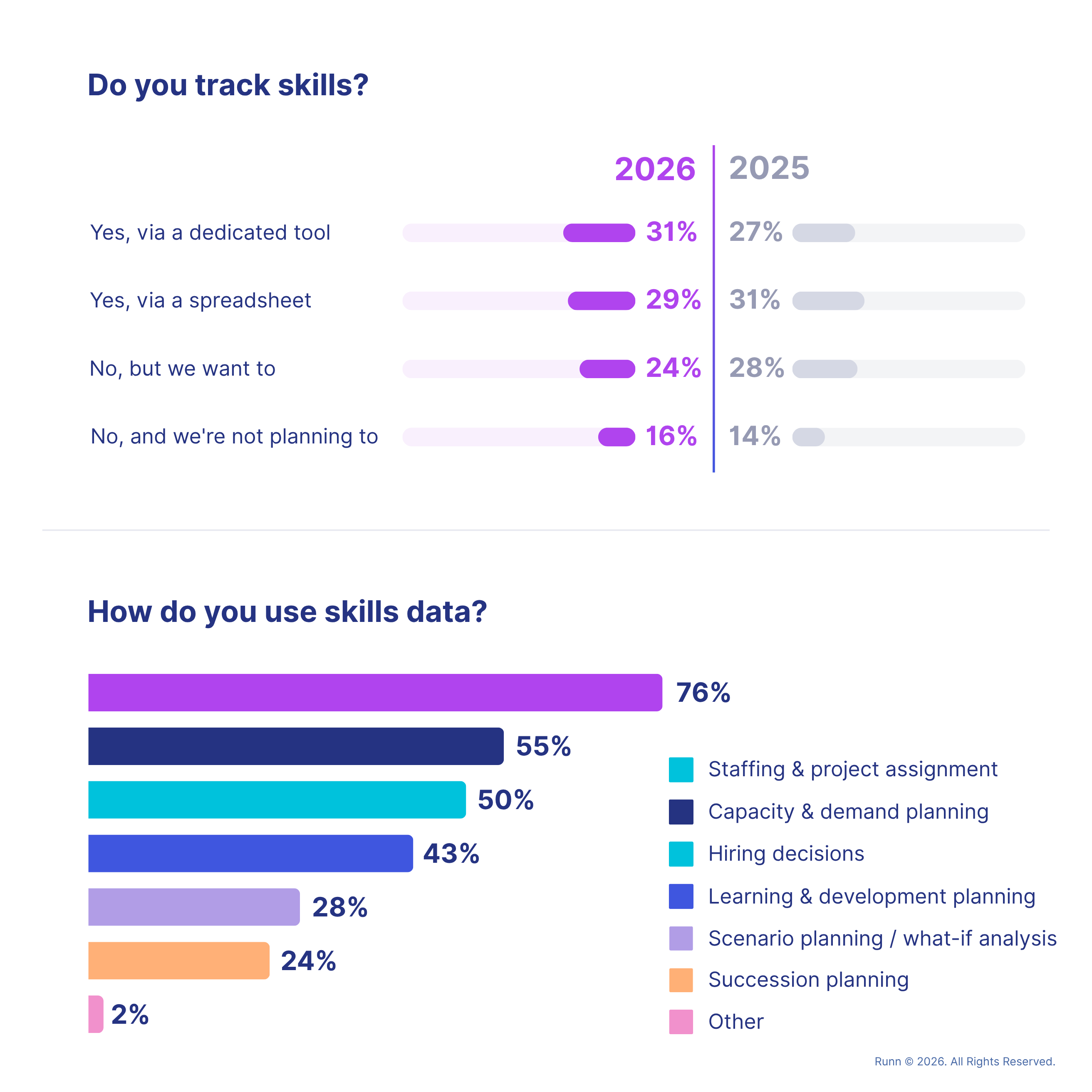
This helps you allocate the right people to projects to deliver great client work. And not just on current projects, but when planning future capacity and workforce development too. Effective skills management delivers short-term operational and long-term strategic benefits. According to Runn's recent survey, more organizations are investing skills-based resource planning and using skills data effectively.
Availability is a great start for effective resource planning. It means people are available to complete work when the project needs them, and helps keep schedules on track. But it isn’t enough – on its own – to guarantee good outcomes. A person may be free, but do they have the skills, experience, and interest to do a great job?
Assigning people purely based on availability doesn’t take into account the following questions. And these are all key to the success of your project allocations.
Assigning someone without the appropriate expertise can lead to delays, lower-quality outputs, and increased supervision needs. On the other hand, assigning someone overqualified may unnecessarily increase project costs. Tracking skills, experience, and proficiency levels ensures that tasks are matched to the right people, improving efficiency, quality, and overall project success.
Some resources are in higher demand than others. For example, your most senior developer or knowledgeable tax consultant. These people need to be allocated to high-value projects where their skills and seniority make a difference to clients. If you’re not tracking skills and skill level, there’s a risk that your MVPs will get assigned to low-value projects that waste their time and talent.
Of course, allocations aren’t just about what the client or the business needs. Employees want to be engaged by their allocations, challenged to develop new skills, or supported to take existing skills to the next level. Information on people’s skills and development needs helps identify opportunities for upskilling or cross-training, which can boost your internal capacity and help retain staff.
To get started with skills-based resource planning, you need a system for capturing people’s skills and keeping them up to date, and a way to surface those skills during the resource scheduling process. It might seem daunting but don’t let perfection prevent progress – you can start small and iterate.
Just get started, because if you overanalyze it, you never will. Start small and then scale it up. Pilot it, pick a department where this is going to have an impact, show the value of it, and communicate that value to get buy-in in the next business unit or wider business. - Oli Meager, Co-founder of Skill Collective
To inform and govern your skills management processes, establish a cross-functional team. Gather departmental heads from different teams together regularly to review the skills matrix, ensure that processes deliver their intended purpose, and that skills tracking serves relevant business goals.
The governance structure is so important. If you’ve got the right structure in place, the business units feel like they have ownership in the skills inventory, rather than it being an HR-driven process. That is gold. Plus, if you're asking business units and business strategy leaders, what work needs to get done, what tasks are being completed in your unit to be able to deliver on your business strategy, you can then elicit the skills from that to make sure that the skills management inventory works. - Oli Meager
There are different levels of skills information you might consider in skills-based resource allocation.
It should be clear by now why those pieces of information are helpful and how to use skills data to your advantage. But it doesn’t mean you have to collect them all right now.
Think about what you’re trying to achieve and just collect the information you need for that goal. You can also add to your skills data and increase your maturity over time.
One of the things that you want to make sure is that you have enough information to make an accurate assignment, but not so much that it’s overwhelming. Businesses will have different needs, but key information might include role, time zone, technical skills, soft skills, language certification, etc. It's a very fine line between “this is too much” and “this is still not enough to make an assignment”. - Julie McKelvey, Global Resource Manager
Your skills management process needs to include a few key steps:
How you conduct this skills inventory or audit will depend on the size of your business and the tools you have available to you:
Decide how you’re going to validate. Is the employee going to self-assess? Or is there room for manager review – having a second set of eyes to confirm that the person is skilled in the way the company defines that skill? - Cyd Mills, Professional Services Strategy and Operations Manager at Instructure
Once you’ve collected and validated your employee skills information, you’ll also need processes for:
This should follow the same format as the original collection – gathering the information, then validating it. You can validate employee skills by looking at their portfolio or past project work, speaking to their manager, looking at formal certifications, or conducting a skills assessment.
Have a process in place that makes it easy for them to update skills. Set expectations and educate people on how to do that. And then it’s just reminder, reminder, reminder. Your skills inventory is really only as great as the information that's in it. You don’t want to get to the end of the quarter and nothing has been updated. - Julie McKelvey
Of course, the information is only valuable to you if it gets used. So the next step is centralizing the skills information somewhere that anyone involved in resource planning can access it – your skills matrix.
You could just use a spreadsheet, but that isn’t very user-friendly or scalable. Ideally, you want a skills management tool that lets users:
Bonus points if your resources and managers can also use the system to input and validate skills data themselves – this makes skills tracking so much easier. A resource management platform like Runn does all this and more.
It’s no good if I've got multiple different profiles in multiple different systems. And maybe one system says I've got great teamwork skills, but then the other system says it's teaming, and then the other system says it's working together with other people. You need to have this common language that can sit across all of that. - Oli Meager
Finally, you need to create and implement a resource allocation process that takes skills-based information into consideration. This will depend on the goals of your resource allocation strategy, such as whether you’re looking to improve quality, schedule adherence, or costs.
However you choose to prioritize different allocation criteria, you need to document the process, share it with anyone involved in allocations, and check it is being implemented consistently.
If you already capture people’s skills, you might want to progress to the next level of maturity of skills-based resource planning.
That involves refining your processes to maximize the benefit you get, like:
Here are some skills management best practices to consider, inspired by our resource management and operations experts.
Any new process adds extra work and friction, and that can create resistance. Education and change management processes can smooth implementation, encourage adoption, and ensure skills-based resource planning delivers desired benefits.
Establish the business and operational benefits of skills-based planning – from better project outcomes, client satisfaction, to more aligned allocations and career development opportunities for employees – and communicate these to stakeholders.
One of the biggest challenges that companies face is justifying this as a business priority. Too often it's seen as an HR initiative rather than a core business imperative. The key is connecting skills to measurable business outcomes. For instance, are we interested in improving our internal mobility rate by X percent? - Oli Meager
People don't really understand the importance of skills-based planning. Go back to that education piece, making sure they understand why we’re doing this and all of the things that this is going to positively impact. - Julie McKelvey
A skills taxonomy just means an agreed dictionary of terms you use to describe different skills. It makes sure that your skills inventory is consistent and easy to search. For example, without a skills taxonomy, someone with JavaScript development skills could log them as:
And that means the person searching for those skills might not use the right words to find them. Whereas, if everyone agrees to use the phrase JavaScript development, people know what to log and what to search, making the whole process more reliable.
Make sure that engineers are engineers, solutions architects are solutions architects, so that you're able to match up that role to the appropriate work, and you don't have random titling out there that throws off the simplification and intuitiveness of using your skills database. - Cyd Mills
Your business has skills gaps, your employees have ambitions. It makes sense to map those things onto one another and see where they match up.
Capturing people’s career development goals helps identify areas where their needs and the firm’s needs align. It means the business gets access to the skills they want, at a lower cost than hiring externally, and your employee feels valued and invested in. Win-win!
And it all starts with skills mapping – just capture upskilling goals at the same time.
In a dream world, I’d want career planning included. Adding in skills that the employee would like to learn on their career journey, so that you can match up that employee to areas that they're interested in learning and growing in. - Cyd Mills
Skills data isn’t just gold for resource scheduling; it can inform wider business decisions like workforce development and capacity planning as well.
Once you have skills data in place in your skills or resource management platform, you’ll be able to run useful reports that reveal how skills are impacting your business.
For example, in Runn, you can view resource utilization rates by skill over time. This reveals whether certain skills are becoming more or less in demand (depending on whether utilization is up or down). And if skills are consistently overutilized, you know it's time to hire or upskill.
Similarly, as part of your strategic capacity planning processes, you can compare skills availability to future demand and make timely decisions about how to fill that gap.
Runn is an intuitive and affordable way to get started with skills-based resource planning, or scale up your current practices.
But that’s not all. Runn is an all-round essential for effective resource management in professional service firms – from resource management to project planning, financials, and reporting.
Discover what Runn can do for you.
The best platform for skills management in a professional services firm is actually a resource management platform. That’s because a resource management platform doesn’t just capture skills information; it makes it immediately actionable. See skills information alongside allocations and availability, then drag-and-drop resources directly into project plans.
You can get buy-in from leadership for skills-based resource planning by highlighting the business benefits. These include cost control, better schedule adherence, quality improvements, higher staff retention, and less reactive hiring.
Skills-based resource planning supports employee engagement – and therefore retention – by matching people to projects that use their skills appropriately and provide opportunities for professional development.
Skills-based resource planning helps find the right people at the right cost, keeping resource allocations within project budgets and protecting profit margins. It also supports employee engagement and retention, which can reduce involuntary turnover.
Skills-based resource planning ensures the correctly skilled staff are assigned to project tasks. This ensures project deliverables are produced by people who know what they’re doing, and do it efficiently and within designated timeframes and budgets.



.png)