Insights from Beth Hunter, Lisa Reed, and Abhishek Gupta on global staffing, operating models, ramp-up, intake, and productive capacity.

Global delivery can expand access to talent, extend coverage across time zones, and create new capacity for growth. But scaling does not happen just because you add people in another location. Without the right operating model, more headcount can create more handoffs, more rework, and more pressure on the teams already doing the work.
In our recent webinar, The Realities of Global Resource Management, practitioners Beth Hunter, Lisa Reed, and Abhishek Gupta shared what it takes to make global delivery work in practice. Their advice points to a clear principle: design the system before you scale it.
Headcount is easy to add. Productive capacity is harder to build.
When an organization expands global delivery, it needs more than a hiring plan. It needs a reliable way to decide which work moves, who owns each step, how teams hand work over, and how quality is checked. It also needs a plan for how people in each location will learn, contribute, and grow.
This is why global delivery should be treated as an operating-model decision, not just a staffing decision. The broader workforce planning models can help frame the planning choices, but they do not replace the operating design required to make delivery reliable. The model needs to connect:
If these pieces are not connected, an organization may increase nominal capacity without increasing reliable throughput.
What started as a cost-arbitrage approach has shifted into operational excellence. Operational excellence shifted into transformation hubs, and transformation hubs shifted into innovation centers. – Abhishek Gupta, Founder & Managing Partner, Pierag Consulting LLP
Let's have a closer look at this change in what global delivery centers were supposed to contribute and how it evolved:
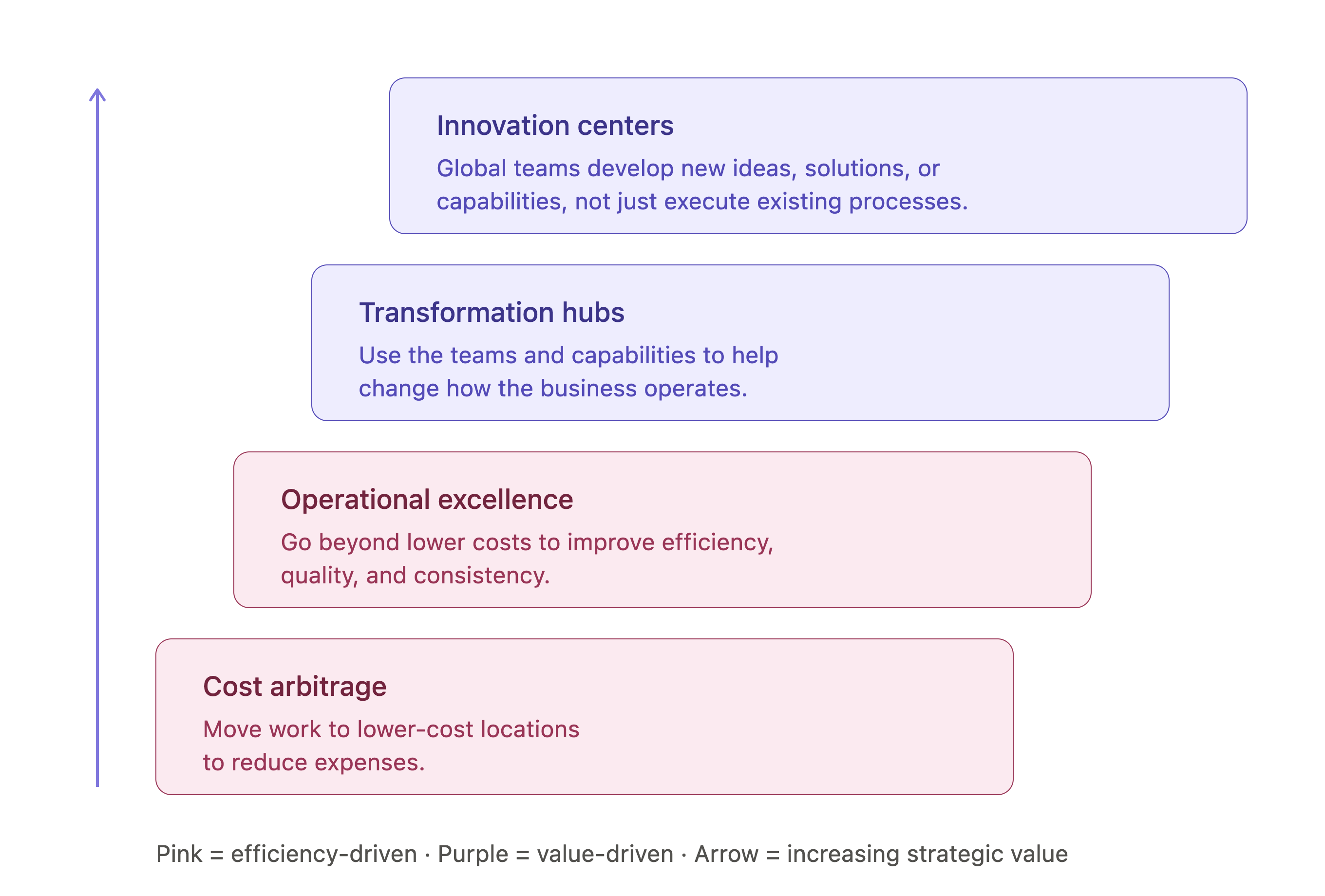
Today, global delivery is increasingly seen as a strategic capability, rather than simply a way to cut costs. The stages are a way to describe the shift in ambition, not a guarantee that every center progresses through them automatically.
Before expanding a global team, define how work will move through the organization with a clear resource management plan. Start with five questions:
The goal is not to design a perfect process on day one. It is to make the important decisions visible so teams can improve the model as they learn.
You really want to design the operating model before you scale it. Headcount is easy to add, but productive capacity requires that operating model. – Lisa Reed, Chief of Staff, Strategic Operations, RRBB
A global team cannot deliver work reliably if it receives incomplete instructions, missing approvals, or unclear review expectations. Before work enters the queue, create a readiness gate.
The gate should confirm that the work has:
A gate should not depend on one person’s memory or availability. Use a checklist, shared workflow, or automated validation where appropriate. The objective is not to slow work down. It is to prevent incomplete work from creating delays later.
Lisa Reed, Chief of Staff, Strategic Operations at RRBB, recommends using a readiness gate before work moves:
You really need a readiness gate. Make sure you have a checklist for documents, instructions, approvals, due dates, and review ownership. It should be one gate, but not one person. – Lisa Reed, Chief of Staff, Strategic Operations, RRBB
A new location or team needs time to build context, relationships, and confidence. It is unrealistic to expect a new team to operate at mature-team performance immediately.
Set explicit ramp-up assumptions before work moves. These might include:
Be careful when comparing utilization, hours, or throughput across mature and developing teams. If one team is still ramping up, its numbers are not directly comparable to a team that has been operating for years. Track progress against the team’s stage of development, and document the assumptions behind the comparison.
Ramp-up is also a people experience. Give team members access to meaningful work, feedback, learning, and a clear path to greater responsibility. A team that is treated only as spare capacity will struggle to build the capability the organization needs.
If you are at the early part of this, be mindful of your utilization targets because new teams will need to ramp up. We can’t put them at 100% early. You’ve got to ramp them up. – Lisa Reed, Chief of Staff, Strategic Operations, RRBB
Global delivery becomes easier to manage when work enters through a shared intake flow rather than through disconnected requests.
A visible queue helps resource managers and global leads see:
The queue should connect the teams sending work with the teams receiving it. Global leads can use their local knowledge to assign work, while resource managers monitor the overall flow and surface imbalances.
This creates a more deliberate alternative to simply sending work to the location with the lowest cost. The right assignment also depends on skills, timing, quality requirements, development opportunities, and the team’s current capacity.
Your intake process converts theoretical capacity into reliable throughput. Name a receiver, have a reviewer, set an acceptance standard, and watch the queue. – Lisa Reed, Chief of Staff, Strategic Operations, RRBB
Resource managers do not need to own every part of global delivery. They do need enough visibility to connect the parts that affect capacity and people.
In practice, that means resource managers can:
Once global delivery is mature, it will be very important for resource managers to advocate equally for everyone, wherever they work. It will be your responsibility to advocate for skills and career development. – Beth Hunter, Resource Experience Management Leader, Rehmann
The resource manager’s role is similar to a lifeguard. They may not own every swimmer or every activity, but they watch the system, spot trouble early, and escalate when intervention is needed.
That role becomes especially important when the organization is expanding global delivery at the same time as it is hiring locally, changing its use of contractors, or introducing AI. These decisions affect one another. A shift in one part of the operating model can change development opportunities, utilization assumptions, and future skill needs elsewhere.
AI can help global delivery teams validate documents, identify missing information, route work, and support repeatable quality checks. It can reduce manual effort and make a readiness gate easier to operate consistently.
But AI should strengthen a designed process, not conceal the absence of one. Before automating, clarify:
A useful principle is one gate, but not one person. A process should have a clear readiness standard without becoming dependent on a single individual who can block the entire flow.
A lot of firms have invested in AI without adjusting the operating model or the processes to support it. Otherwise, you’re just making a broken process faster. – Lisa Reed, Chief of Staff, Strategic Operations, RRBB
Before expanding a global delivery model, ask:
Global delivery can create real strategic value. It can improve coverage, expand access to skills, and help organizations build capability in new markets. But those outcomes do not come from location or headcount alone.
They come from a system that makes work ready, moves it clearly, supports people as they ramp up, and gives resource management enough visibility to keep the flow healthy.
Abhishek Gupta, Founder & Managing Partner of Pierag Consulting LLP, puts the principle plainly:
The underlying asset for global delivery to be successful is talent – your global workforce. We need to understand the talent rather than treat people as a commodity. – Abhishek Gupta, Founder & Managing Partner, Pierag Consulting LLP
Treating people as a source of capability rather than as interchangeable capacity is what turns global expansion into sustainable performance.
Start with the operating model. Then scale the team.