
Learn what IT operations means in 2026, what ITOps teams do, and how IT solutions firms can improve delivery, capacity, and margins.

Every IT operations manager has a version of the same horror story. Systems go down at the worst moment. A senior engineer gets pulled off a critical project to handle an escalation. Sales agrees to a new engagement without checking whether the team can actually deliver it.
These moments feel like bad luck. They're not – they're the result of a gap between how work gets planned and how it actually gets done. Great IT operations closes that gap.
This article covers what ITOps means in practice for client-facing delivery firms, the challenges teams face, and how better resource planning helps you stay ahead.
IT operations – sometimes called information technology operations or ITOps for short – is the function responsible for managing and maintaining the systems, IT infrastructure, and tools that keep software delivery running.
In services businesses, that means both your own internal environment and the client environments you're directly responsible for.
Where an internal IT team serves a single business, ITOps in a software or IT firm sits at the intersection of delivery and infrastructure.
So, what does IT operations do? In software and IT firms, ITOps covers a broad and often overlapping set of responsibilities, from low-level infrastructure to client-facing service delivery. Here's what that looks like in practice.
.png)
Managing ITOps in a delivery firm isn't a single job, but a cluster of interdependent roles.
The exact structure depends on the size of the business, the complexity of client work, and the services being delivered. A smaller IT solutions firm may have generalists covering infrastructure, support, and deployments. A larger software delivery organization may split responsibilities across DevOps, cloud, security, support, service delivery, and capacity planning roles.
IT operations teams face plenty of technical challenges: complex infrastructure, security risk, system performance, incident response, and changing client requirements.
But for software and IT firms, the hardest problems are often planning problems. Teams need to balance client demand, specialist availability, support commitments, project margins, and delivery risk at the same time.
These are the pressure points that tend to cause the most trouble.
Skills availability. Headcount may look fine on paper, but it doesn’t mean the right skills aren't available for a specific client environment or technology stack.
Specialist bottlenecks. Senior engineers, architects, and security specialists get pulled across pre-sales, delivery, escalations, and reviews simultaneously. Hello, bottlenecks.
Attrition risks. Cloud engineers and DevOps professionals are in high demand externally, making attrition a constant risk. When key people leave, the impact hits multiple client engagements at once.
Read more: How to Optimize Resources in IT: Getting the Most from Your Team's Time 👉
Strong IT operations teams do more than keep systems running. In software and IT firms, good ITOps helps teams deliver client work reliably, respond to support issues without derailing projects, and make confident decisions about capacity.
Operational efficiency metrics like uptime and incident resolution time are valuable but they can create a misleading picture of health if delivery risk is building underneath. Track efficiency alongside capacity and workload data, so that good SLA performance doesn't mask an overloaded team heading toward a cliff edge.
Further reading: How to measure operational efficiency in service-based environments ➡️
One of the most common planning failures in ITOps is treating reactive support as a background activity rather than a real demand on capacity.
When allocating people to project work, the time they spend on managed services, incidents, and internal requests needs to be visible in the same view, otherwise you're planning against availability that doesn't actually exist.
Read on: How to improve IT project success rates ➡️
Role-based planning is rarely enough for technical teams. "We have a DevOps engineer available" is not the same as "we have the right person for this AWS migration."
Effective resource planning in ITOps requires maintaining a clear view of skills, certifications, and system knowledge, so you can match the right people to the right work and spot bottlenecks before they delay delivery.
Sales and delivery leaders should never be agreeing to new engagements (or expanded scopes) without a clear picture of ITOps capacity.
That means looking at confirmed work, tentative pipeline, support load, planned leave, hiring timelines, and specialist availability over the next 90 to 180 days.
Capacity planning becomes a decision-making tool. Instead of saying yes and solving the problem later, teams can make informed tradeoffs before delivery risk builds.
👉 Go deeper: IT Capacity Planning: The Ultimate Guide for 2026
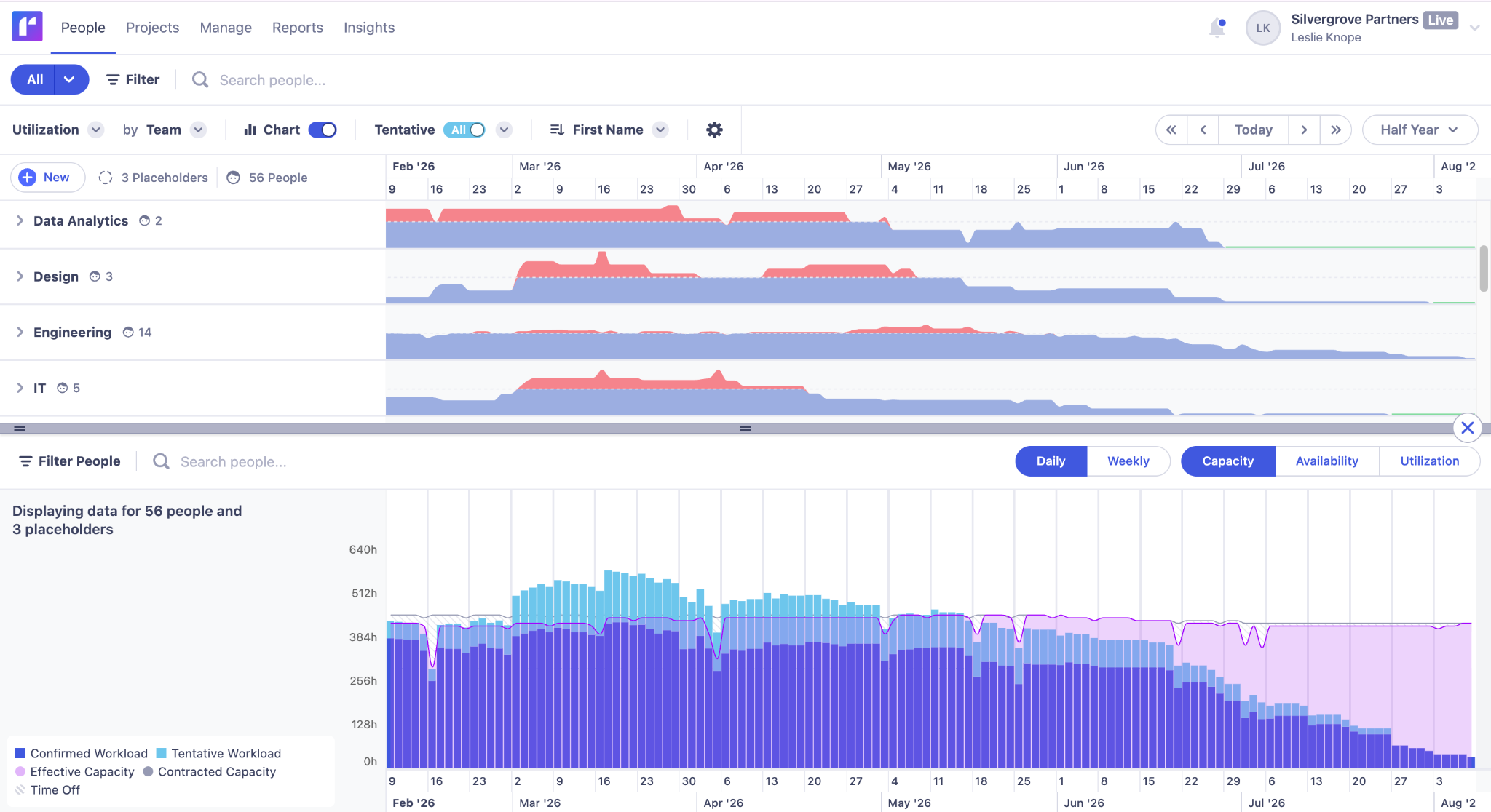
When resourcing information lives across spreadsheets, project tools, and individual managers' heads, decisions get made on incomplete or outdated data.
A single source of truth that shows who's allocated to what, what's coming up in the pipeline, and where the gaps are is the foundation for every other practice on this list.
Operational metrics like uptime and incident resolution still matter, but they should be read alongside delivery, utilization, capacity, and margin data.
Most ITOps teams are managing a mix of project work, managed services, support load, and internal activity, often across multiple clients at once.
The real challenge isn't simply doing that work, but knowing at any given moment what capacity is actually available, and making decisions you can stand behind.
That’s where resource management comes in.
ITOps capacity is rarely as straightforward as it looks on paper. An engineer might be nominally available but carrying a significant support load. A specialist might be allocated to three projects while also being the go-to for escalations. Utilization numbers can look healthy while individuals are stretched thin.
Good resource and workload management surfaces that reality before it becomes a delivery problem. When you can see billable work, support commitments, and internal activity in one place, resource allocation decisions get sharper. You're matching people to work based on what they can actually absorb, not just what the calendar suggests. And when a delivery lead wants to pull someone off a managed services engagement to staff a new project, you have the data to show exactly what that trade-off costs.
Strategic capacity management is what lets you make commercial commitments with confidence, and answer questions like:
Modeling those scenarios before they become urgent changes the conversation ITOps can have with sales and delivery leadership. Less "we'll figure it out". More "here's what we can take on, and here's what we'd need to take on more."
Read more: Why resource management is critical for project delivery success 👉
Ollion is a 400-person cloud consultancy with teams across the USA, India, and Singapore. Before Runn, their operational teams worked in silos – different systems, formats, and cost rates created duplicated effort, made planning data hard to trust, and meant manual forecasting consumed multiple days of management time each month.
With Runn, we reduced our operational footprint and increased profitability. The synergy between teams is much stronger, and everyone now works from a single source of truth. That means better decisions, faster, so we can achieve more with less.” – Csaba Muha, Ollion’s Head of Governance and Operations – APAC
Runn gave Ollion one source of truth for people, projects, utilization, and financial data. The result: faster, more proactive decisions around hiring and restructuring, a reduced operational footprint, and forecasting that went from days to hours.
The gap between what gets promised and what the team can actually deliver is almost always a planning problem. Runn gives IT operations leaders the visibility to close that gap: a clear picture of who's available, what skills they have, and how current allocations stack up against incoming demand.
Whether you're managing a growing managed services practice, supporting complex client delivery environments, or just trying to get ahead of the next scheduling crisis, Runn gives you the data to plan with confidence.


.png)


