
Increase your project delivery confidence for more predictable outcomes, happier customers, and consistent profits

Project delivery confidence is the level of certainty that a project will meet the scope, schedule, and quality expectations that were promised from the outset.
It’s a shared sense that what has been committed to can realistically be achieved. You’re not just hoping on a wing and a prayer that things will go well – you’re confident that the right calls have been made to set the project up for success.
That level of certainty requires clear goals, measurable progress, active risk management, and continuous communication. But above all, it depends on accurate scoping and a realistic, data-driven understanding of the capacity required execute the work from day one.
Project delivery confidence matters because where confidence leads, predictable execution follows.
When you lack a clear view of scope and capacity, planning becomes speculative. Bottlenecks emerge where resource constraints were never acknowledged, expectations drift beyond what is realistically achievable, and risks surface too late to be managed effectively.
You already know where this leads:
Learn more: How to Calculate and Analyze Project Profitability ➡️
There’s an old saying that ‘No one wants to see how the sausage is made’, the idea being that if the consumer saw the process, they’d no longer want or trust the product.
The same could be said for many busy IT and software firms. You might be proud of the products you deliver. But if a customer saw how you actually arrived at their new solution – the controlled chaos, firefighting, and RAG risks – they might think twice about working with you again.
Delivery confidence comes from seeing the full picture early, which empowers you to make decisions that are grounded in reality. Any trade-offs or compromises can be controlled and intentional rather than forced by circumstance.
Delivery confidence comes when your project governance is underpinned by repeatable, stress-tested processes, realistic capacity estimates, and accurate forecasts. This is where resource management and project management collide.
With these processes in place, you can more consistently commit to delivery milestones with confidence.
This is how you create the procedures and practices that will fill your teams and your clients with confidence:
99 times out of 100, just having the right people available at the right time to do the work as promised is going to be your biggest constraint. As such, it’s often the factor that confounds confident delivery commitments the most.
Your business development team might want to sell a project on the promise that it will be completed within six months. But if you just don’t have the resources available to make that timeline work, you can’t commit to it in good faith and full confidence.
Former Senior Project Manager (also, CEO & Co-Founder of Runn! 👋), Nicole Tiefensee cites this confusion and misalignment around capacity as the prime suspect for undermining project delivery confidence in her experience:
In my time as a PM, I had many miscommunications where our Sales team promised a client a specific project start date without checking with me first. And then we couldn’t actually start because of resource constraints. This is really hard to handle, because the first thing you’ve done before you even start the work is disappoint the customer.”
Solving this problem is a major piece of the delivery confidence puzzle. So what should you do?
You need one centralized source of truth for your capacity and scheduling information that each team can cross-reference before any firm commitments are made.
Without this shared view, decisions are made in isolation, assumptions creep in, and confidence quickly erodes.
Spreadsheets are a fragile foundation for this kind of decision-making. They are highly manual, difficult to keep up to date, and very easy to misinterpret. Version control becomes a constant risk; access has to be tightly managed. The more people rely on the spreadsheet – sales, delivery, leadership – the higher the chance that someone is working from outdated or incomplete information.
Further reading: 5 Signs That a Delivery Team Has Outgrown Spreadsheets ➡️
Instead, use a purpose-built resource and capacity planning tool to provide controlled visibility instead of uncontrolled access. This way, the whole team can stay across availability, constraints, and upcoming bottlenecks in real-time, while protecting the integrity of the underlying data.
.png)
'What-if' planning is a powerful tool to strengthen your project plans and prevent them from imploding when they meet the reality of competing commitments and capacity constraints.
By exploring different scenarios – for example, seeing what happens if you shift start dates around or allocate different resources for different phases of a project – you can expose the potential bottlenecks and resource constraints that would represent delivery risks once the rubber meets the road.
It also anchors the discussion of feasibility in data and evidence, removing the need to defend what might otherwise be dismissed as a “gut-feeling”.
Instead of just saying “I don’t think we can deliver that,” you can show why a plan is risky – where the constraints are, what would have to change to make a timeline possible.
This reinforces delivery confidence by turning uncertainty into clear, data-backed choices, and showing how your plan accounts for different risk conditions.
Early in a project, certainty is low, and change is inevitable. Diving straight into task-level planning at this stage creates a false sense of precision and can actually reduce delivery confidence in the long run, rather than improving it.
Instead, plan at the right level of abstraction. Use resource placeholders for major phases, workstreams, or roles, and focus on understanding the sequence of work, any dependencies, and, crucially, realistic capacity management.
In other words, at this stage, don’t focus on exactly what tasks people will be doing. Concentrate instead on understanding the skills required to deliver the work, and whether you have the people available to do that work.
.png)
Delivery confidence improves dramatically when forecasts are grounded in what has actually happened before, not just what you’re hoping will happen this time.
Past project data – estimates versus actuals, delivery velocity, resource utilization, and recurring bottlenecks – provides an objective baseline for future planning.
But this data is only useful if it’s available, accurate, and actionable. The higher the quality of your historical and current data, the more reliable your forecasts will be.
This is where a purpose-built resource management tool makes a difference: by tracking capacity, assignments, and progress in real time, it creates a wealth of project performance data that you can use for forecasting. It captures trends that can be turned into lessons for the future.
Learn more: How to Improve Software Project Estimation ➡️
Planning purely around job titles can hide both risk and opportunity. When work is assigned based only on roles, critical skills may be overbooked without visibility, while capable team members are left underutilized or on the bench.
A skills-based view of capacity reveals where specialist knowledge is actually required, where work can be flexibly absorbed, and where upskilling or rebalancing can reduce risk.
This approach improves delivery confidence by reducing single points of failure, making better use of available talent, and protecting high-performing individuals from burnout, while ensuring valuable capacity isn’t wasted.
Effective prioritization depends on a clear, shared view of both available capacity and team skills, as well as consensus around what decisions ought to be made for strategic reasons.
Without this transparency into how and why plans are made (or changed), overall delivery confidence inevitably suffers.
Regular interlock meetings help create this clarity and boost delivery confidence by providing a structured forum to review, challenge, and validate resource capacity plans before commitments are finalized.
These sessions ensure that priorities are realistic, trade-offs are understood, and work is assigned to the right people at the right time.
Last on the list, but definitely not bottom of mind, is communication. You can do everything right behind the scenes, but if stakeholders don’t know what’s happening, confidence will slip.
Regular, transparent updates help turn potential surprises into manageable adjustments. They allow stakeholders to see the impact of changes on both schedule and cost, and give delivery teams the space to make informed decisions before small issues escalate.
Stakeholders need regular updates in order to feel confident in the project’s direction,” says Nicole. “This is particularly important for time & materials projects (even though they’re less common these days), as any delays or additional time required will usually need to be covered by the customer. For that, you absolutely need to let them know early.
But even with fixed-price projects, you want to keep a close eye on this. You’ve built in a margin, and any overruns will quickly eat into that, so you want to keep an eye on both the financials as well as the capacity and resourcing.”
Having access to the right data in a clear, presentation-ready format is a huge bonus here. Status reports supported by clear numbers and timelines inspire more confidence than vague, vibes-based updates.
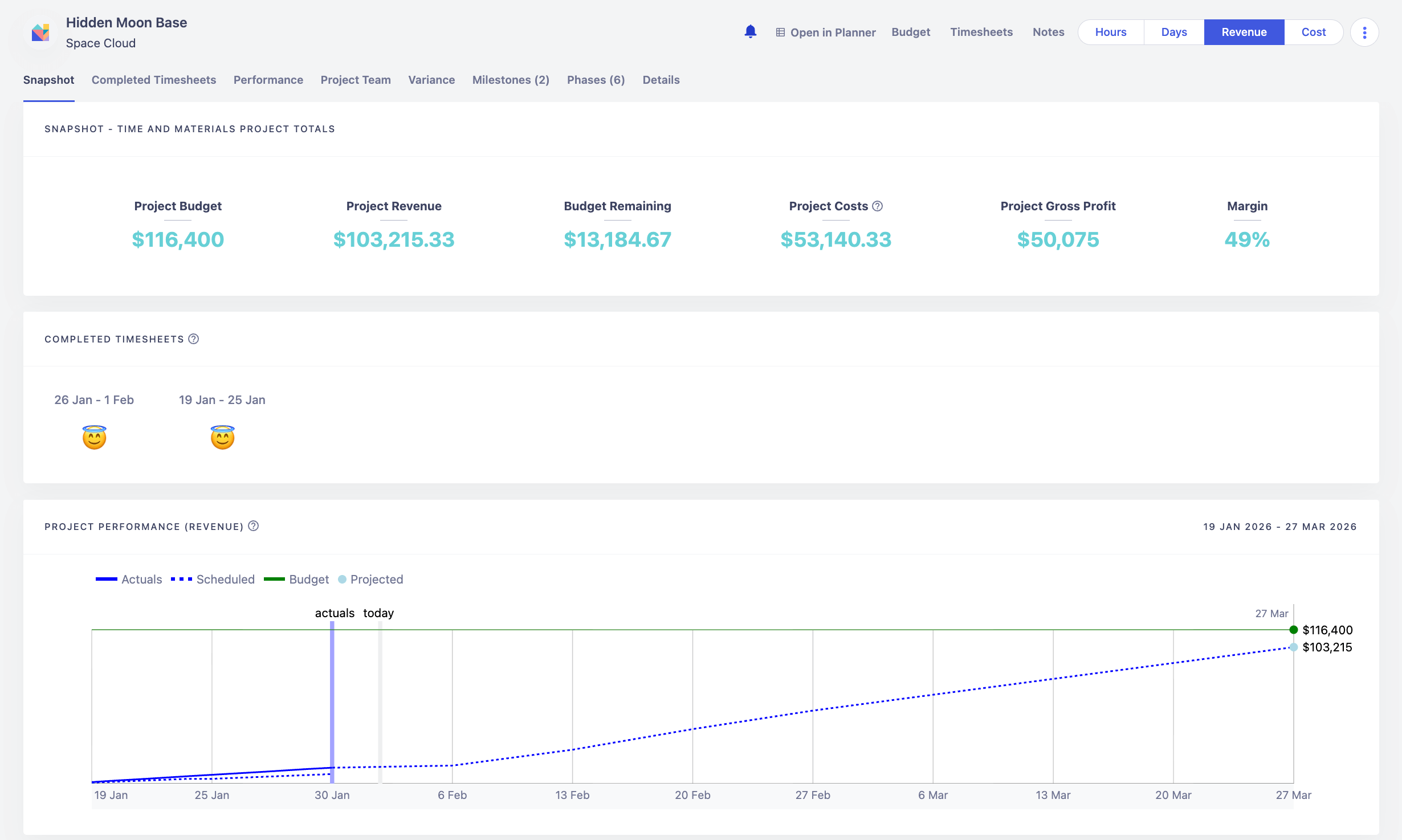
Even if the project is facing challenges, presenting transparent, relevant metrics demonstrates that issues are understood, measured, and actively managed.
When you can clearly show what’s happening and why, you position yourself to steer the conversation – and the project – to a better outcome.
Confidence comes from knowing you’ve done everything you can to ensure a successful outcome. It doesn’t have to be perfect – you just have to know you’ve left nothing to chance.
It may not surprise you, given that you’re reading this on the Runn blog, that this is exactly what the Runn platform is designed for.
Runn gives delivery leaders, project managers, and operations teams the visibility and control they need to commit to work with confidence:
And that’s just the start. If you want to improve confidence in your project delivery, the right capacity planning tool makes all the difference.
Start your free 30-day trial now with just your email address.


